During my first year in Japan, I lived an existence quite like an average Japanese salaryman, living in a company dormitory, eating most meals from what I could buy at a convenience store or izakaya, having a long commute to the office, and having nowhere private I could spend time with my girlfriend. (Women were not allowed in my dorm.) Like most unmarried Japanese women, (girlfriend) Kaori lived with her parents, so she had nowhere private to spend time with me, either.
We thus did what most Japanese people our age did: we went to "love hotels." Unlike their low-rent American equivalent, the no-tell motel, love hotels tended to be more cheesy than sleazy. The decor was routinely tacky, featuring as you might imagine, "fantasy" themes like Greek columns or floor-to-ceiling mirrors. However, love hotels were generally clean, discreetly located in back alleys away from prying eyes, and relatively inexpensive. They were conveniently priced for a three-hour "rest" during the daytime or an all-night "stay" from 10:00 pm to 10:00 am. Some tourist books used to advise people traveling to Japan on the cheap to stay in love hotels, although you have to be out during the daytime and can't leave your luggage there. I once stayed overnight in a love hotel in Kamakura when nothing else was available on short notice.
In the suburbs, love hotels tend to cluster near highway exits, and are noticeable from their excessive use of neon and their architecture, which runs from the Parthenon to Magic Kingdom. In cities, they tend be located near major train stations, usually on back streets away from where the main entertainments are.
The area of Tokyo known as Shibuya has a fairly extensive love hotel area, known colloquially as "hoteru gai" ("hotel town" or "hotel street"), which sits atop one of the hills that surrounds the Shibuya train station and shopping district. Hoteru Gai is a warren of back streets, many of them dead ends, most of them containing love hotels of one description or another, ranging in price from reasonable to very expensive. Because Shibuya was convenient to both of our homes (in the sense that we could both easily get to Shibuya by train), Shibuya was a regular meeting place for me and Kaori. We also had a couple of regular spots in Hoteru Gai.
Kaori being only 20 (I was 22!), she was still subject to a curfew of last train, and it was rare that we booked a "stay." But on one occasion, we stayed overnight on a weekday. The next morning, we left the hotel early to get to work -- just like everyone else in all the other hotels in Hoteru Gai. We walked out onto the street and were joined by a few other people leaving the other hotels on our alley. Our alleyway emptied into a larger street, and as each successive alleyway fed into the main street, the trickle grew into a human stream. Couples reaching the main street immediately broke away from each other and walked separately. Everyone walked briskly, making for the station, their eyes strictly in front, no one (except me) looked around for fear of making eye contact with an acquaintance, a gossipy co-worker or a friend of their real girlfriend or boyfriend. By the time we reached Dogenzaka Street, a major shopping street running down the hill to Shibuya Station, the trickle from our alleyway had become a river of people running down to the station, everyone speeding as quickly as possible away from Hoteru Gai, making for the plausible deniability of Shibuya Station.
Showing posts with label Japanese Living Arrangments. Show all posts
Showing posts with label Japanese Living Arrangments. Show all posts
Monday, August 31, 2009


Thursday, June 25, 2009
The Company Dorm
In the early 1990s, a perk of working for a large company like Canon was the company dormitory. Given the high cost of housing in Tokyo, dormitories were a great benefit, offering small but clean accommodations for a fraction of what an apartment would cost. Employees could live in a dorm while they were single, and many were eligible to move to subsidized family housing when they got married. The only disadvantage of the dorms was that, in return for their low price, they tended to be very far away.
During my time in Japan, I lived in two Canon dormitories, the Canon Fujigaoka Dormitory No. 1 in deepest Yokohama, and the Mushashi-Nitta Dormitory in Ohta Ward, literally on the edge of Tokyo, near the Tamagawa River dividing Tokyo from Kawasaki. (More on Musashi-Nitta in a later post.)
A company dorm was usually overseen by a long-time company employee. A managership was a way of rewarding a valued employee who did not rise to senior management with a free apartment and a few additional years on the company payroll beyond the mandatory retirement age. The overseers of Fujigaoka No. 1 were Arai-san and his wife. Like many Japanese men in his late 40s or early 50s at the time, Arai-san stopped keeping up with popular fashions in the 1970s and favored tinted eyeglasses and shaggy hair. The Arais were extremely concerned about me adjusting to dorm life and made sure that the guys living there welcomed me too.
At the dorm's entrance, there was a concierge window where you could receive mail, pick up dry cleaning, and make pay phone calls in the days before cell phones. Next to the window was a board with a name plate for each person hanging on a hook according to room number. The red side meant you were out, the green side meant you were in, and you were supposed to turn it to the appropriate side when you came or left. I thought this was extremely paternalistic -- whose right is it for anyone to know where I am!, I thought -- but I eventually realized it was just practical. It saved the Arais the trouble of going all the way to your room when you got a phone call or had a guest, only to find that you were not there.
After flipping over your name plate, you turned left, into the shoe box area. Each person had their own box for keeping shoes and slippers in -- this being Japan where shoes were only worn outside and slippers were worn inside the dorm. Once you had changed your footwear, you stepped up from the genkan (entrance) into the dorm itself. For those of you who have never traveled to Japan but plan to go there someday, a step up is usually a signal that you need to take off your shoes, and the genkan is almost always a step or two lower than the floor of the house.
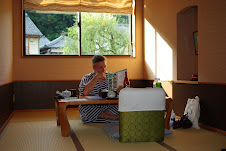
Most employees living in the dorm shared a room. As a foreign intern, I got a room to myself -- probably because Canon feared both that, as an American, I could not live in such a small room with someone else and that a Japanese employee would consider it a hardship to have to share such close quarters with an American, who was assumed not to speak Japanese and to have uncouth foreign habits. The dorm had no cafeteria, but it had a kitchen for us to use, along with a TV room. Each floor had a large common bathroom. Like a Japanese-style inn, the shower and o-furo (bath), a vital part of any Japanese living quarters, was on the first floor. The o-furo was communal, about two feet deep so that you could sit in it neck deep and soak, and the size of a small swimming pool. (I know from experienced that you can swim in some of these large o-furo, even though that's bad form.) My dorm-mates frequently invited me to join them in the o-furo after we'd been drinking together, but during my first months in Japan I was still not comfortable with the idea of sitting naked in a bathtub with a bunch of other men and always begged off. I eventually learned to love the o-furo and its relatives the sento (public bath) and onsen (hot spring bath) as much as the Japanese do. But it was several years in coming. Oh, think of all the o-furo time I missed!
During my time in Japan, I lived in two Canon dormitories, the Canon Fujigaoka Dormitory No. 1 in deepest Yokohama, and the Mushashi-Nitta Dormitory in Ohta Ward, literally on the edge of Tokyo, near the Tamagawa River dividing Tokyo from Kawasaki. (More on Musashi-Nitta in a later post.)
A company dorm was usually overseen by a long-time company employee. A managership was a way of rewarding a valued employee who did not rise to senior management with a free apartment and a few additional years on the company payroll beyond the mandatory retirement age. The overseers of Fujigaoka No. 1 were Arai-san and his wife. Like many Japanese men in his late 40s or early 50s at the time, Arai-san stopped keeping up with popular fashions in the 1970s and favored tinted eyeglasses and shaggy hair. The Arais were extremely concerned about me adjusting to dorm life and made sure that the guys living there welcomed me too.
At the dorm's entrance, there was a concierge window where you could receive mail, pick up dry cleaning, and make pay phone calls in the days before cell phones. Next to the window was a board with a name plate for each person hanging on a hook according to room number. The red side meant you were out, the green side meant you were in, and you were supposed to turn it to the appropriate side when you came or left. I thought this was extremely paternalistic -- whose right is it for anyone to know where I am!, I thought -- but I eventually realized it was just practical. It saved the Arais the trouble of going all the way to your room when you got a phone call or had a guest, only to find that you were not there.
After flipping over your name plate, you turned left, into the shoe box area. Each person had their own box for keeping shoes and slippers in -- this being Japan where shoes were only worn outside and slippers were worn inside the dorm. Once you had changed your footwear, you stepped up from the genkan (entrance) into the dorm itself. For those of you who have never traveled to Japan but plan to go there someday, a step up is usually a signal that you need to take off your shoes, and the genkan is almost always a step or two lower than the floor of the house.
Most employees living in the dorm shared a room. As a foreign intern, I got a room to myself -- probably because Canon feared both that, as an American, I could not live in such a small room with someone else and that a Japanese employee would consider it a hardship to have to share such close quarters with an American, who was assumed not to speak Japanese and to have uncouth foreign habits. The dorm had no cafeteria, but it had a kitchen for us to use, along with a TV room. Each floor had a large common bathroom. Like a Japanese-style inn, the shower and o-furo (bath), a vital part of any Japanese living quarters, was on the first floor. The o-furo was communal, about two feet deep so that you could sit in it neck deep and soak, and the size of a small swimming pool. (I know from experienced that you can swim in some of these large o-furo, even though that's bad form.) My dorm-mates frequently invited me to join them in the o-furo after we'd been drinking together, but during my first months in Japan I was still not comfortable with the idea of sitting naked in a bathtub with a bunch of other men and always begged off. I eventually learned to love the o-furo and its relatives the sento (public bath) and onsen (hot spring bath) as much as the Japanese do. But it was several years in coming. Oh, think of all the o-furo time I missed!
The last thing to note about the dorm was the curfew. At 11:00 pm, the front gate closed and the door was locked. Again, having come from college dorms where I could come and go as I pleased, bring women into my room, etc., I thought a curfew was too paternalistic for grown men. However, I soon learned that the back door was unlocked all night. This was a perfect example of the Japanese concepts of honne (true feeling/intention) and tatemae (a person's facade). The front door -- the public face of the dorm -- was the tatemae that said everyone had to be home by 11:00 pm or suffer the consequences. The back door was the honne that recognized we were all adults.
Subscribe to:
Posts (Atom)


 Posts
Posts


